The BDO Zone Summit 2021: Two-Hour Panel Discussion

The BDO Zone Summit 2021: Two-Hour Panel Discussion
On August 17th, 2021, Ecostrat Inc. proudly hosted the first ever Bioeconomy Development Opportunity (BDO) Zone Summit. The virtual 2-hour event featured three panels of discussion, key community leaders, capital markets and project developers, that voiced their perspectives of the BDO Zone Initiative and its positive impact.
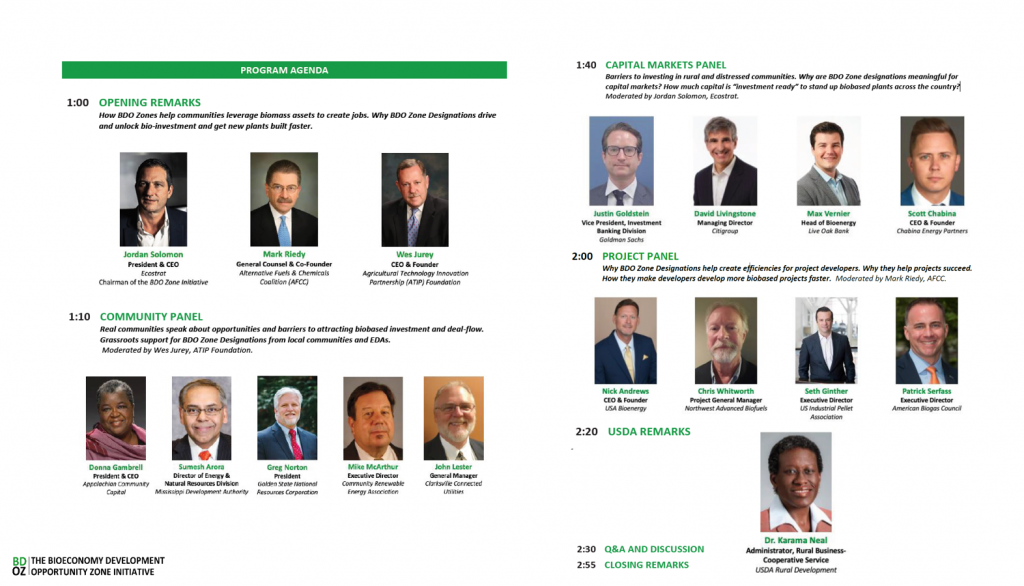
With over a dozen speakers amongst three panels, the Summit was moderated by Jordan Solomon (President & CEO, Ecostrat; Chairman, BDO Zone Initiative), Wes Jurey (CEO & Founder, ATIP Foundation) and Mark Riedy (General Counsel & Co-Founder, AFCC) with concluding remarks from Dr. Karama Neal (Administrator, Rural Business Development Cooperative Service, USDA Rural Development).
Below, panelists highlighted the biggest challenges they face in their respective fields as well as the ways in which the initiative can help solve some of those hurdles:
BDO ZONE SUMMIT PROGRAM AGENDA
SUMMARY OF MODERATOR REMARKS
Jordan Solomon (CEO & President, Ecostrat Inc.; Chairman, BDO Zone Initiative)
- “BDO Zone Ratings are powerful economic development tools that help attract biobased manufacturing plants to the areas where they are most likely to succeed and where they will have the greatest social impact”.
- “BDO Zones designations enable communities that have biomass assets to leverage those assets as engines for new bio-based economic development”
- “The bottom line is that BDO Zones designations solve a big problem for distressed communities, which is that many of them have strong bio-based assets: tremendous surpluses of biomass, reliable suppliers, and good operating infrastructure to support an operating plant, but they don’t have the budget, the platform, or the credibility to communicate this to biobased investors and developers around the world. A BDO Zone designation changes all that”.
- “One of the main contributions of our collaborators and partners, the ATIP Foundation, is to facilitate educational development if it’s lacking and if new skills are needed to supply the workforce to new operating plants. This initiative has the boots and the skills on the ground to make that happen”.
Wes Jurey (CEO & Founder, Agricultural Technology Innovation Partnership (ATIP) Foundation)
- “We believe that this is one of the critical five key economic foundations necessary to ensure that we can grow the bioeconomy throughout the United States”.
Mark Riedy (General Counsel & Co-Founder, Alternative Fuels and Chemicals Coalition (AFCC); Partner, Kilpatrick Townsend & Stockton LLP)
- “As a project finance lawyer, I’m trying to stand these projects up. The most important thing is to find a site and where you can place your project and that’s why these BDO Zones are so important. The critical first step is finding feedstock”.
- “These projects are all working with biomass. When you’re dealing with biomass, you’re trying to mitigate risks which are predominately on the feedstock side, quality and quantity, and to get to your financing, and these projects at the end are all a benefit to the environment. They create jobs and they bring revenues into distressed communities”
SUMMARY OF COMMUNITY PANEL REMARKS
Donna Gambrell (President & CEO, Appalachian Community Capital)
- “The work that we do really is so much about the job creation, about supporting those businesses that are creating jobs, and, of course, we know that in many cases small businesses are the backbone of our economy”.
- “The work that we see in the BDO Zone Initiative is one in which we would be leveraging resources, working with members in those designated areas to ensure that they are supporting small businesses”.
Sumesh Arora (Director of Energy & Natural Resources Division, Mississippi Development Authority)
- “We need to take a much more comprehensive look in terms of looking at the full life cycle of where the feedstock is coming from, how well it can be transported, how long it will be available for, who are the stakeholders in it, and making sure it’s a good process”.
Greg Norton (President, Golden State Natural Resources Corporation)
- “The biobased community credibility through a designation I believe can be very helpful in a number of ways. Even in a project like ours, in addition to bringing investor interest and confidence, we’re planning on issuing debt and discussing it with equity investors. We’ve already initiated those processes and I believe it could be very beneficial to it.”
- “Off-takers have a need for comfort in feedstock access, volume, quality, sustainability and consisted volume over a period of years; I think the BDOZ can be very helpful towards that and if so, would also provide additional comfort to off-takers in the length of those agreements which is important in a development process”.
Mike McArthur (Executive Director, Community Renewable Energy Association)
- “We think that the BDO Zone might help enhance the interest in the investment with folks who have the capital necessary to make these projects work. It would help leverage additional resources.”
John Lester (General Manager, Clarksville Connected Utilities)
- “I think we’re ripe for this type of designation. In fact, we’ve started moving down the process with Ecostrat and have a grant request with the RBDG Program. We intend to use those dollars to help start the process for the BDO Zone. We think that we have enough unique features for this community that if we can take that extra step, that will put us on the radar that much more”.
- “In the end, it’s about good-paying jobs. That’s ultimately why we’re the most interested in moving forward with a BDO Zone”.
SUMMARY OF CAPITAL MARKETS PANEL REMARKS
Justin Goldstein (Vice President of the Investment Banking Division, Goldman Sachs)
- “The work you have to do to secure feedstock is hard work. Developers have a lot they have to pull together to do a project. Raising a capital loan is a full-time job when you have to combine it with all of the groundwork like meeting with the farmer at 7 am at the diner. It’s a lot. So if communities come with a rating that shows that they can help on that end, I think it’s an enormous benefit to the developers we work with”.
- “The hardest thing is raising equity. A lot of these are risky, have a lot of downsides, and have a lot of components that are complicated, and so I think this BDO Zone initiative that helps address one of the critical legs of the stool is going to be good for the sector to help get more projects done”.
David Livingstone (Managing Director, Citigroup)
- “Feedstock is one of the four main pillars to getting these projects financed”.
- “We’re working on a number of projects and virtually all are in rural areas and distressed communities. One of the issues is making these communities aware that they can get this designation”.
- “Local support of projects is another critical step because if the local community isn’t as supportive of a project, then they can delay permits and challenge things and those delays are what kills projects”.
- “Getting to the point where you’re ready to finance is the most difficult capital to raise and anything you can do, and this BDO Zone initiative is doing that, to not have to worry about things like infrastructure, feedstock, or maybe having to worry a lot less is very important”.
Max Vernier (Head of Bioenergy Finance, Live Oak Bank)
- “I see projects all the time that get dragged on for months if not years because they have obstacle after obstacle just getting a conditional use permit. A lot of times we see, especially in small towns, where big infrastructure projects are slated to be constructed, a lot of folks don’t understand the benefits that it can bring to their community”.
- “It’s important that as a part of this initiative, we can also bring education to understanding some of the benefits of these bioeconomy solutions”.
Scott Chabina (CEO & Founder, Chabina Energy Partners)
- “The perception around these local feedstock supply chains require that level of sophistication that we’re doing through these BDO Zone ratings and it’s critical”.
- “The capital on the ESG front is there. The projects at mid to large scale are there. The opportunities are there. We’re having this alignment where the programs can really make a huge difference in valorizing projects”.
SUMMARY OF PROJECT PANEL REMARKS
Nick Andrews (CEO & Founder, USA BioEnergy)
- “As a developer, our site selection criteria are paramount and take a whole lot of time, so if there were 1,000 BDO Zones that showed low biomass feedstock-risk of course we’d like to know that. It would be a neon sign for a local economic development community to say ‘We’re open for business!’”.
- Working on economically distressed communities and bringing jobs to rural areas represents a valuable proposition.
Chris Whitworth (Project General Manager, Northwest Advanced Biofuels)
- “The desire to have businesses be able to develop in an area where a lot of businesses that have been forest-related have left”.
- “… From our project alone, we will create hundreds of forest [jobs]”.
- “In terms of a BDO Zone, we are in an opportunity zone. What you’re offering here with the BDO Zone Initiative is a phenomenal opportunity for all of us to get together and work with finance markets and get our projects going”.
Seth Ginther (Executive Director, US Industrial Pellet Association)
- “I think the BDO Zones are a way to continue to unlock that economic impact and make things easier and get things built faster”.
- “I really do see these BDO Zones as an opportunity to fast-track. The idea that it would attract additional financing opportunities I think is also key to all of this and we can’t discount that at all”.
Patrick Serfass (Executive Director, American Biogas Council)
- “There are three top challenges that almost every project developer across the US is dealing with today. Locating feedstock and making sure that the feedstock is quality; permitting; and access to low-cost financing. The BDO Zones can check all three of those boxes”.
- “We don’t have any roadblocks, but we have all these little speedbumps. If we can flatten out some of those speedbumps, progress is going to be a lot smoother and it’s going to happen faster”.
SUMMARY OF USDA REMARKS
Dr. Karama Neal (Administrator, Rural Business Development Cooperative Service, USDA Rural Development)
- “This is the kind of candid, and thorough feedback that is stage setting, and really helpful for us when we evaluate our programs, propose program revisions and when we develop new programs”.
- “We do all of this to encourage not just rural prosperity, but inclusive rural prosperity”.
- “At USDA Rural Development, we are committed to helping improve the economy and the quality of life in rural America. That makes me very glad to be [at the BDO Zone Summit]”.
- “[The RBDG] is very well aligned with BDO Zone determination, for example. If more of these projects are able to get through and get funded, and people use it and are interested in that program, that could increase the use of our RBDG funds in disadvantaged areas”.
- “The fact that [the BDO Zone Initiative] is so targeted to disadvantaged communities/distressed communities oftentimes, that is certainly helpful”.
Originally published at bdozone.org.